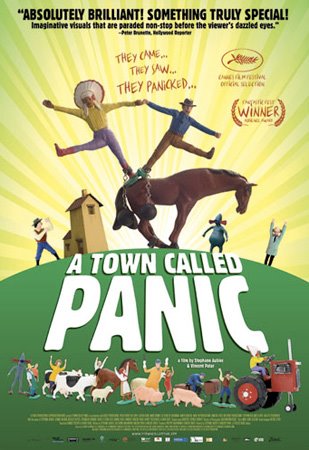
Few people could guess the adventures that filmmakers, Stephane Aubier and Vincent Patar, will share in their first feature film, “A Town Called Panic” as the movie opens on picturesque small town. Before long, viewers realize that it is not such an ordinary town and Aubier and Patar want viewers to escape to a place where anything can happen.
Opening the door to one of the homes in this town, there is no traditional family. Instead, viewers are introduced to Horse (voiced by creator Vincent Patar), the most responsible individual in the household, and his two far more adolescent companions, Cowboy (voiced by creator Stephane Aubier) and Indian (voiced by Bruce Ellison). Cowboy and Indian only seem concerned with fun until they forget Horse’s birthday and must scramble to find a gift. Finally, they decide to build him a present using bricks but in a technology gone wrong moment, they order far too many bricks when they accidentally add extra zeros to their online order. This sets off a series of events that could not happen in a live-action film.
Aubier and Patar are able to bring this unusual tale to life using stop-motion animation, or continually moving static objects to tell the story. In fact, the film, based on a French-language Belgian television series of the same name, is the first stop-motion picture to be an official Cannes Film Festival selection. This style of animation allowed viewers to accept the world of this zany comedy and the many misadventures of these characters. From being suspended in mid-air between boulders to visiting an underwater world, the film is reminiscent of a make-believe world of childhood cartoons but with a comedic flare that adults can enjoy as well.
However, adults may become frustrated by the lack of character development in “A Town Called Panic.” Viewers meet Horse, Cowboy, and Indian and quickly come to understand their different personalities; however, it is unclear why and how they all decided to live together. How are they related? Friends? Family? Viewers never find out. During the first portion of the film when character development typically occurs, the filmmakers seem far more concerned with using slapstick comedy to make the audience laugh. The budding relationship between Horse and the music teacher Madame Longrée (voiced by Jeanne Balibar) is one of the only formative partnerships in the film.
Without the necessary character development, “A Town Called Panic” loses its ability to make a real connection with audience members beyond making them laugh for an hour and fifteen minutes. The stop-motion animation also hinders the ability to connect with what is happening on screen. The static faces and limited movement of the characters restrict the amount of emotion that Horse, Cowboy, and Indian can show throughout the film.
While actually finding a connection to the characters proved to be difficult, it was fun to watch them as they as they used silly antics to overcome dilemmas. Aubier and Patar clearly want viewers to escape with them into this alternate universe. And, they succeed. They create a fast-paced film where any scenario can (and probably is) brought to life. From blizzards to dark caves, the filmmakers use vibrant colors and contrast between dark and light to keep the audiences’ eyes on the screen. The use of color and toy-like characters is a great fit for a movie that is designed to be a break from reality and delve into the world of fantasy. The film invites viewers to forget about their everyday lives and to only be concerned about Horse, Cowboy, and Indian.
While the story lacks character development and emotional attachment, the filmmakers still created a fun-filled movie that is unlike anything else in theaters today. The film takes viewers on crazy adventures at every turn and is not afraid to break the boundaries of traditional animated pictures. “A Town Called Panic” goes to show that anything is possible with outside-the-box thinking and an online brick order gone awry.
 Stephanie Wenger