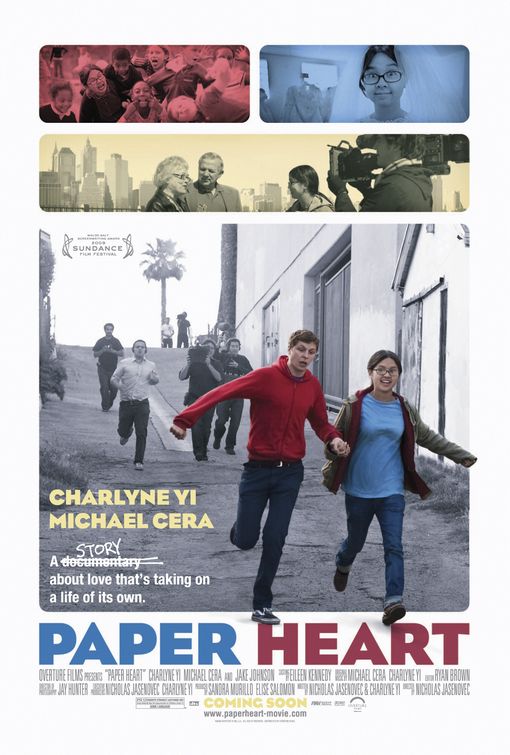
Does anyone believe in love anymore? How does one find love? How do you know that it’s love? It is these questions that comedian Charlyne Yi sets out to answer in the documentary meets romantic comedy, “Paper Heart.” The unlikely melding of film genres may seem off-putting to some moviegoers; but, in this case, viewers will surely be able to forget where the reality ends and fiction begins.
“Paper Heart” chronicles Yi’s real-life adventures traveling across the country in an effort to learn more about love, soul mates, and marriage as well as her not-so-real relationship with fellow actor, Michael Cera. No distinction is made between the actual people interviewed and her faux relationship in the film. In fact, to know the difference, a viewer would have to read an interview with the filmmakers or see a review like this one.
Viewers meet Yi in one of the least romantic places in the world, the middle of the Las Vegas strip as she holds her microphone and asks people about the meaning of love. Along her travels, she meets everyone from an Elvis impersonator to college professors who give her insights into that one four-letter word. She visits Vegas wedding chapels, biker bars, courthouses (to find out what happens when love fails), and even playgrounds where kids describe what love means to them.
However, she remains skeptical of the idea and continually wonders if she is lovable. At the beginning of the film, Yi proclaims, “I believed in it when I was a kid. But, then again all of my ideas about love kind of come from movies and fairytales. As I grew up, I realized that life is nothing like that.”
Back in Los Angeles, Yi meets a potential new love, Cera, when she attends a low-key house party. In an oh-so-middle-school moment, Cera quickly admits to Yi’s friend and the film’s director Nicholas Jasenovec, played by the likable Jake Johnson, that he likes her. Rather than focus on big romantic moments, this film tries to move past the fairytale cliques and look at the smaller moments in relationships from eating lunch at local favorite, Jerry’s Deli, to browsing in a music store together.
With no barriers between documentary and romance, the film feels organic and unrehearsed regardless of whether Yi is browsing the aisles of a supermarket with Cera or interviewing a young couple about their decision to get married. Jasenovec told USA Today that, “The film had to feel as real as possible for the two sides of the film to blend together and work together. The fake stuff had to feel as real as the documentary stuff.”
“Paper Heart,” which won a screenwriting award at the 2009 Sundance Film Festival, is all about Yi whether she is telling other people’s stories or her own. Her take on love. Her questions to interviewees. Her silly glances at the camera. This film could not work without her. She is the consummate storyteller who allows audiences to connect with each love anecdote seen onscreen. She brings a mix of wit and naiveté to her role. Yi appears remarkably genuine both during interviews and while developing her relationship with Cera.
It is difficult to tell whether Yi’s character in “Paper Heart” is a persona she developed specifically for the film or a true representation of herself. The filmmakers want viewers to believe that they are seeing the real Yi. Jasenovec incorporates home videos from her childhood, footage from her act as stand-up comic, and short interviews with her real-life friends including her “Knocked Up” costar, Seth Rogan, and fellow comedian, Demetri Martin.
Yi also brings her trademark comedic style to the film. She first began performing at AA meetings, veteran’s homes, and biker bars in Fontana, California. She has since created her own stage show, “The Doo Doo Show” and has a cult following in Los Angeles. Yi explains to USA Today, “My humor isn’t meant to be mean or hurt anyone. But it’s to make them uncomfortable and laugh. I like making people feel a different range of emotions. I like to make people a bit confused.”
While Yi is clearly the focal point of the film, Cera also offers a believable performance as a version of himself. He is not afraid to appear awkward at times but also allows audiences to see his growing connection with Yi. However, the role is reminiscent of parts that he has played especially playing a gawky but lovable father-to-be opposite Ellen Page in “Juno.”
Cera is a rising star in Hollywood and eventually admits his discomfort at having cameras follow his relationship with Yi. In this way, the film is about more than just love; it also looks at the pressures that celebrities feel when being hounded by the ever-present paparazzi. Cera portrays himself as an actor who wants to maintain a private life, which cannot happen in the midst of making “Paper Heart” with Yi.
The filmmakers break the traditional romantic comedy formula in “Paper Heart.” They are unconcerned about creating the perfect fairytale moments and instead explore the foundation of love for various people. From gay couples to a man who lost touch with his soul mate, the movie looks at why some relationships work and other don’t. Viewers quickly realize that there is not simply one type of love and it is left up to them to decide what love means in their own lives.
However, the film is not broken into section by grouping relationship types together. Instead, it seamlessly intertwines interviews with various couples and Yi’s own romance with Cera. The film is divided into parts by location making audiences feel like they are on the journey with Yi as she discovers more about love (and maybe finds it herself.)
At times, the film appears to be more like the behind-the-scenes of “Paper Heart” as viewers see Yi prepares for interviews with Jasenovec, type instant messages to Cera, and travel from place to place in a van. The filmmakers also allow audiences to see the audio people and cameramen that surround Yi, which only adds to the authentic feel of the movie.
However, Yi and Jasenovec, who wrote the film together, add a little movie magic by using puppetry to tell many of their interviewees’ stories. The use of puppets is unexpected and fun. Yi began doing this art form as a child and put on shows for her family. For “Paper Heart,” Yi and her father created dolls that would match each love story and then used the various puppets and a rear projection system to create the scenarios.
Music also plays an integral role in the storytelling. Yi and Cera bond over their mutual love of song. Yi shows off her unique talents as a songwriter when she writes a song about Cera, which is not only one of sweetest moments in the film but also provides insight into her emotions and true feelings about falling in love.
While some audience members will have difficulty wrapping their heads around this documentary-romance hybrid, “Paper Heart” shows viewers that true love still exists and you don’t need perfect lighting, hair and makeup people, or designer clothes to find it.
 Stephanie Wenger