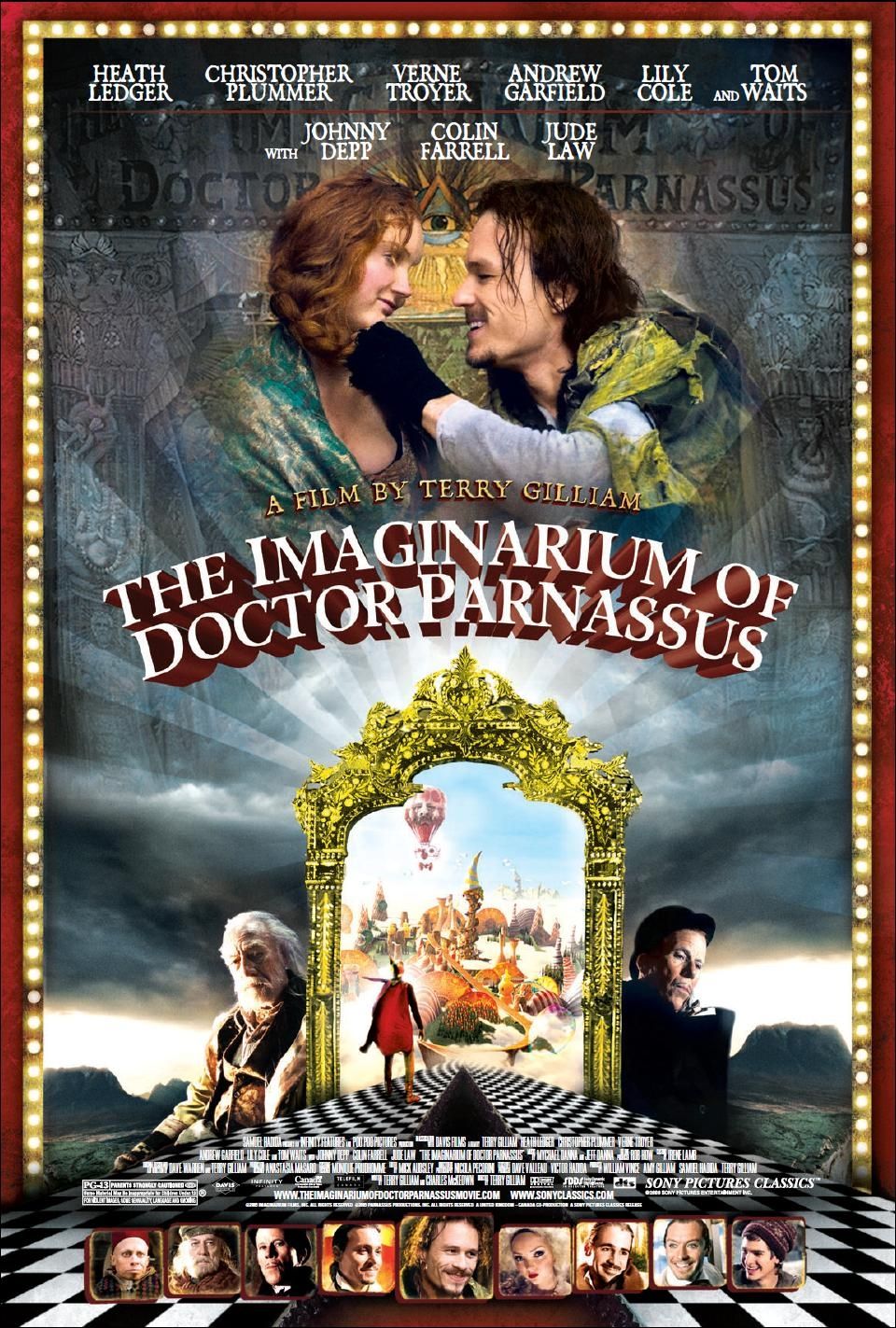
Enter the world of Terry Gilliam’s “The Imaginarium of Doctor Parnassus” and you’ll soon discover that it’s unlike any other traveling theater production. Doctor Parnassus (Christopher Plummer) invites viewers into a fantasy where far-fetched desires seem possible if they will go through the aging mirror on his stage. From a ride on a gondola with a dreamy lover to an endless supply of designer shoes, the film straddles two worlds: the realistic modern-day London where the struggles of everyday life are clear and CGI fantasyland where nothing seems out of reach (but probably should be).
The film constantly begs the question: if you were able to have everything you ever wanted, would you happy? It’s not only viewers of the street show that struggle to see the consequences of their own greedy desires, Doctor Parnassus himself selfishly makes a deal with the devil to become immortal in exchange for his daughter Valentina’s soul upon her 16th birthday. The devil (Tom Waits) returns and says that he will accept five other souls instead.
His promise to Satan is not Dr. Parnassus’ only concern; few people are interested in his show and he needs to find a way to make money. Therefore, he and his fellow performers constantly travel trying to find new locales for their show. One evening, while trekking through the outskirts of town, they discover a man named Tony hanging from a bridge. After his rescue, Tony quickly joins their ensemble and becomes an integral part of luring audiences to the show.
Heath Ledger plays the complex character of Tony with a necessary blend of charisma and deception in his final screen performance. Ledger died in the middle of production in January 2008 from an accidental overdose of prescription medicines at the age of 28. Gilliam completed the project by introducing Johnny Depp (who he had previously worked with on “Fear and Loathing in Las Vegas”), Jude Law, and Colin Farrell as versions of the Tony character.
The performances by these three well-established actors are thought provoking and shine light on different aspects of Tony’s character. Farrell brings a dramatic flare to the role and highlights many of the character’s past struggles. However, Gilliam’s use of multiple Tony characters leaves viewers with little continuity throughout the film. The only visual connection between the actors is the white suit worn by all four during the filming.
The story itself seems undermined by the use of multiple actors. Audiences feel short-changed as they never get to truly see the Tony character transform in any way as new actors are continually introduced throughout the film. In addition, the style and tone of each actor is different and it takes a few minutes to adjust when a new Tony appears during fantasy sequences. Each character brings a different element of the Tony character to life; however, it is left to audience members to paint the picture of the entire man.
In addition to the way the story materializes on screen, one of the films greatest flaws seems unavoidable. At each turn throughout the film, Ledger’s death looms larger than the often slow plot line. You can’t help but wonder how the film would differ if he was able to complete the role.
The supporting cast of characters offers a reprieve from the ongoing Tony saga. Lily Cole as Valentina brings the struggles of her character’s nomadic life to the screen with realism and grace. Andrew Garfield plays fellow street performer, Anton, with naiveté as viewers watch him develop feelings of unrequited love for Valentina. However, the relationship between Valentina and Anton is often lost in the circus of other plot lines. In addition, Verne Troyer under whelms as Doctor Parnassus’s midget friend, Percy.
While Gilliam’s experiment with Ledger’s character may have not been entirely successful, he shows that he still a mastermind at creating unforgettable fantasy sequences with vibrant colors and an outside the box imagination. In particular, he paints a candyland-like image of a woman’s frivolous desire for shoes and necklaces. Throughout the film, he makes these sequences jump off the screen by juxtaposing them with images of a gloomy London backdrop.
Gilliam deserves credit for trying to salvage a picture that many would have left on the cutting room floor following Ledger’s death. It’s a must see for fans of Ledger and Gilliam. Yet, its offbeat style of storytelling will leave most viewers wishing they never went to see the traveling circus in the first place.
 Stephanie Wenger